What is sinking funds?
Every year, the same expenses catch people off guard.
Car registration in March. Holiday shopping in November. Back-to-school in August. Annual insurance premiums in April.
None of these are surprises. They happen every single year, on roughly the same schedule. But most people don’t plan for them — and when they arrive, they go on a credit card.
Sinking funds fix this completely.
What Is a Sinking Fund?
A sinking fund is money you save in advance for a known, future expense.
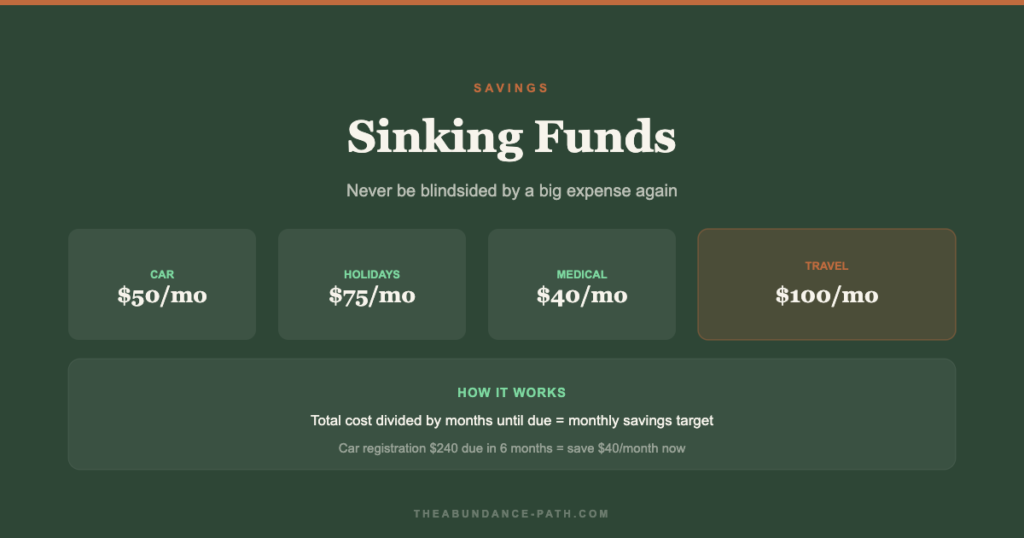
You take the total cost, divide it by the number of months until you need it, and save that amount each month. By the time the expense arrives, the money is already there.
Example: Car registration costs $240 in December. That’s 6 months away. You set aside $40/month starting now. In December, you pay cash — no credit card, no stress.
Sinking Fund vs. Emergency Fund: What’s the Difference?
These are two different tools for two different situations.
Your emergency fund covers unexpected expenses — things you couldn’t predict. Job loss. Medical emergency. A pipe bursting at 2am.
Your sinking fund covers expected irregular expenses — things you know are coming but don’t happen every month.
Most people use their emergency fund for both, which means it’s always getting depleted. Keep them separate.
Common Sinking Fund Categories
Start with whatever applies to your life. Common ones include:
- Car maintenance & registration — tires, oil changes, DMV fees
- Holiday gifts — Christmas, birthdays, graduations
- Annual subscriptions — Amazon Prime, software, memberships
- Medical/dental — copays, glasses, dental work
- Home repairs — appliances, HVAC maintenance, tools
- Travel — flights, hotels, road trips
- Back to school — supplies, clothes, fees
You don’t need all of them on day one. Pick the two or three that catch you off guard most often and start there.
How to Set One Up
Step 1: List your irregular expenses for the next 12 months. Go through last year’s bank statements and look for anything that doesn’t show up every month. Add up the amounts.
Step 2: Calculate monthly savings needed. Divide each expense by the number of months until it’s due. This is your monthly target for each fund.
Step 3: Open a savings account (or sub-accounts). Some banks let you create multiple savings “buckets” or sub-accounts within one account. Ally Bank, Capital One 360, and SoFi all support this. Name each one after its purpose.
Step 4: Automate the transfers. Set up automatic monthly transfers on payday. Treat them like bills — non-negotiable.
How Much Should You Have in Sinking Funds?
It depends on your expenses. A good starting target is $100–$300/month across all your sinking funds combined. That might cover car maintenance ($50), holiday gifts ($75), and travel ($100).
As you identify more irregular expenses, you’ll add more funds. Over time, you’ll reach a point where almost nothing catches you financially off guard. That’s the goal.
The Bottom Line
Sinking funds don’t require extra money. They require planning. You’re not spending more — you’re spending intentionally, on a schedule that works for you instead of against you.
Set up one fund this week for the next expense you know is coming. Watch how different it feels when it arrives.
The Weekly Check-In tab in the free Abundance Path Starter Kit is perfect for tracking your sinking fund progress each week alongside your regular budget.
More articles
 Savings
How to Build a $5,000 Emergency Fund Starting From Zero
One flat tire. One ER visit. One layoff. That’s all it takes to go from “doing fine” to financial freefall when you…
Read → Savings
How to Set Up Automatic Savings
Read → Savings
High-Yield Savings Accounts: Why Your Bank Is Quietly Costing You Money
Most banks pay almost nothing on savings. A high-yield savings account fixes that in one afternoon, no risk and no investing knowledge required.
Read →