A bad credit score costs you real money. Higher interest rates, declined applications, higher insurance premiums, rejected rental applications.
The good news: credit scores are not permanent. They’re calculated fresh every month based on your current behavior. That means they can go up — and faster than most people think.
Here’s what actually works.
How Your Credit Score Is Calculated
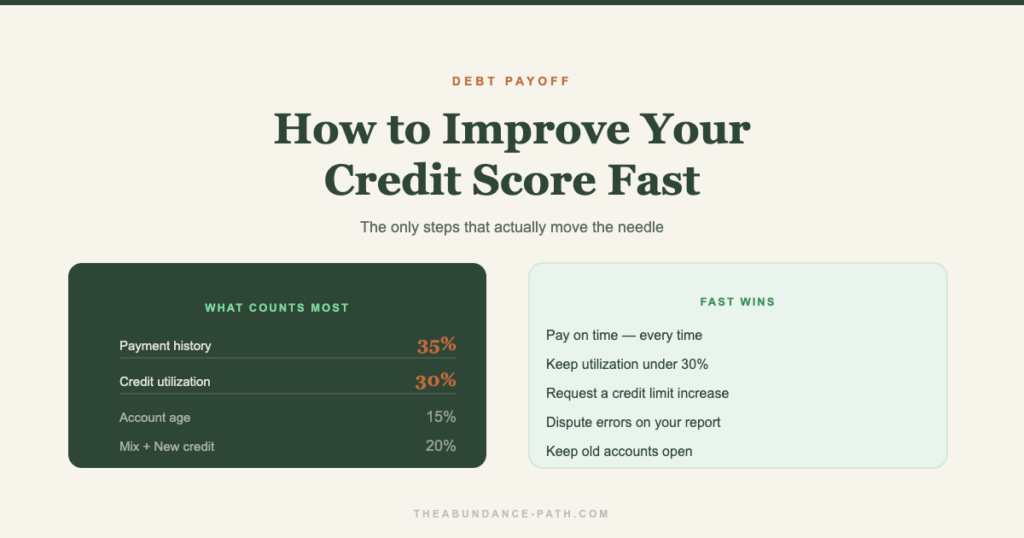
FICO scores — the most widely used — are calculated from five factors:
- Payment history (35%) — Whether you pay on time
- Credit utilization (30%) — How much of your available credit you’re using
- Length of credit history (15%) — How long your accounts have been open
- Credit mix (10%) — Types of credit you have (cards, loans, mortgage)
- New credit (10%) — Recent applications and hard inquiries
The top two — payment history and utilization — make up 65% of your score. Fix those two and your score moves significantly.
Step 1: Never Miss a Payment Again
One missed payment can drop your score 50–100 points and stay on your report for 7 years. This is the single most important factor.
Set up autopay for at least the minimum on every account. You can pay more manually — but autopay ensures you never accidentally miss a due date.
If you’ve already missed payments, the damage fades over time as you build a clean record. Recent on-time payments matter more than old late ones.
Step 2: Lower Your Credit Utilization
Credit utilization is the percentage of your available credit you’re using. If you have a $5,000 limit and carry a $2,500 balance, your utilization is 50% — which hurts your score.
The target: under 30% on each card. Under 10% is even better.
Two ways to lower it fast:
Pay down balances. Even a partial payoff can move your score noticeably within one billing cycle.
Request a credit limit increase. If your card issuer raises your limit and you don’t increase spending, your utilization ratio drops immediately. Call your issuer and ask — many will approve without a hard inquiry if you’ve had the card for 6+ months.
Step 3: Don’t Close Old Accounts
Closing a credit card reduces your available credit (raising utilization) and can shorten your average account age. Both hurt your score.
Even if you don’t use an old card, keep it open. Use it for a small recurring charge — a streaming subscription — and pay it off monthly. This keeps the account active and your history long.
Step 4: Check Your Credit Report for Errors
One in five credit reports contains an error. These errors can drag your score down for years without you knowing.
Get your free reports at AnnualCreditReport.com (the only FTC-authorized source). Look for:
- Accounts that aren’t yours
- Incorrect late payment records
- Balances that are wrong
- Accounts that should have fallen off (negative items disappear after 7 years)
If you find an error, dispute it directly with the credit bureau (Equifax, Experian, or TransUnion) online. They have 30 days to investigate. Removing a false negative mark can raise your score significantly.
Step 5: Don’t Apply for New Credit Unnecessarily
Every hard inquiry (when a lender pulls your credit for an application) can drop your score 5–10 points temporarily. Multiple applications in a short period signal financial stress to lenders.
Apply for new credit only when you need it. If you’re shopping for a mortgage or car loan, do all applications within a 14–45 day window — bureaus count rate-shopping inquiries as one.
How Fast Can You Actually See Results?
Realistically:
- 30 days: Paying down utilization shows up in the next billing cycle
- 1–3 months: Consistent on-time payments start building positive history
- 6 months: Meaningful score improvement visible if you’ve fixed utilization and payments
- 1–2 years: Recovering from serious negative marks (missed payments, collections)
There’s no shortcut that bypasses time. But the steps above are real — they work because they directly address how your score is calculated.
What Doesn’t Work
Credit repair companies that promise to remove accurate negative items — they can’t. Only time removes legitimate negative marks. Any company claiming otherwise is either wrong or lying.
Tracking your debt payoff alongside your credit improvement? The free Abundance Path Starter Kit includes a net worth tracker where you can watch your total debt drop month by month.
More articles
 Debt Payoff
Debt Avalanche vs. Debt Snowball: Which Method Gets You Out of Debt Faster?
Debt avalanche saves more money. Debt snowball builds momentum. Here's the honest comparison — and how to pick the right method for your personality.
Read → Debt Payoff
Debt Consolidation: Does It Actually Help or Make Things Worse?
Debt consolidation sounds like a fix. Sometimes it is. Sometimes it makes things worse. Here's how to tell the difference before you sign anything.
Read → Debt Payoff