Most people know they need an emergency fund. Most people don’t have one.
Not because they’re irresponsible. Because nobody taught them how to actually build one — especially when every dollar is already spoken for.
This guide fixes that.
What Is an Emergency Fund?
An emergency fund is money set aside for unexpected expenses — a car repair, a medical bill, a job loss — that you didn’t see coming and couldn’t wait on.
It lives in a separate savings account. It is not invested. It is not touched for non-emergencies. It is the buffer between you and debt every time life happens.
How Much Do You Actually Need?
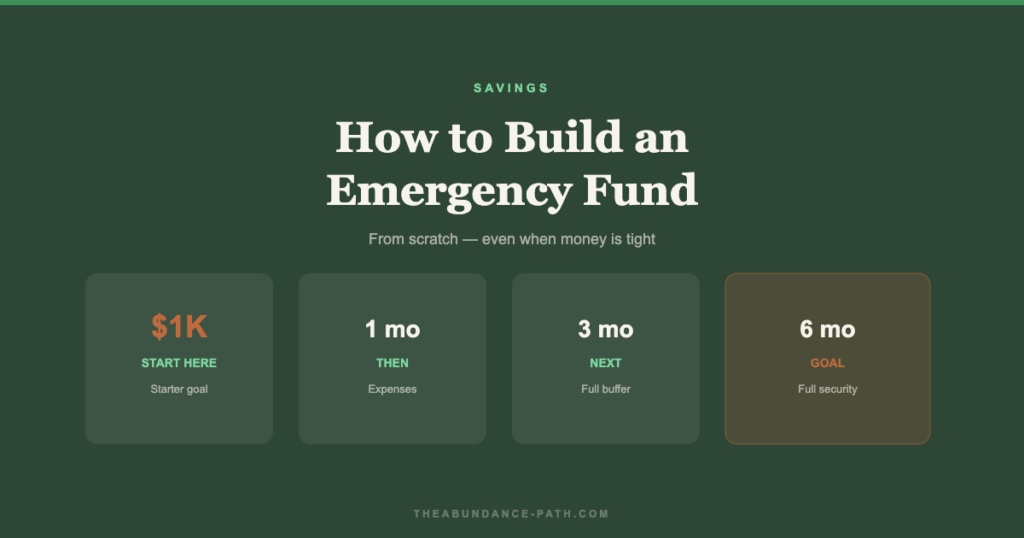
The standard advice is 3–6 months of expenses. That’s the right long-term goal. But if you have zero saved right now, that number can feel paralyzing.
Here’s what actually works:
Start with $1,000.
A $1,000 starter emergency fund covers the most common unexpected expenses: a flat tire, a busted appliance, an urgent copay. It won’t cover everything, but it will stop most emergencies from becoming debt.
Once you hit $1,000, you build toward one month of expenses. Then three. Then six. You do it in stages, not all at once.
Step 1: Open a Separate Account
Your emergency fund needs to be separate from your checking account. If it’s in the same account as your spending money, it will get spent.
Open a high-yield savings account (HYSA). Right now, many are offering 4–5% APY. Your money earns interest while it waits. Good options include Marcus by Goldman Sachs, Ally Bank, and SoFi.
The account should be easy to transfer from but not linked to a debit card. A little friction is good — it prevents impulse withdrawals.
Step 2: Set a Monthly Savings Target
You don’t need to save $1,000 in a month. You need to save something consistent every month until you get there.
Even $50/month gets you to $600 in a year. $100/month gets you to $1,000 in 10 months.
Pick a number that’s honest, not optimistic. Then automate it — set up a recurring transfer on payday so the money moves before you can spend it.
Step 3: Find the Money
If your budget is already tight, you need to find the savings somewhere. A few places to look:
One-time windfalls. Tax refund, birthday money, work bonus, selling something. Redirect the whole thing (or half) before it disappears into everyday spending.
Subscription audit. Go through your bank statement and cancel anything you forgot about or rarely use. $30–$80/month is common here.
One temporary cut. Pause dining out, delivery apps, or one hobby for 60–90 days. It doesn’t have to be forever — just long enough to build the foundation.
Extra income. Even one extra shift, one sold item, or one freelance gig can jump-start your fund faster than cutting alone.
What Counts as an Emergency?
This is where most people slip up. The fund gets used for things that aren’t emergencies, and then when a real one hits, the account is empty.
An emergency is: unexpected, necessary, and urgent. A car repair is an emergency. Christmas is not. A medical bill is an emergency. A sale is not.
Expected irregular expenses — car registration, annual subscriptions, holiday gifts — belong in a sinking fund, not your emergency fund.
What If You’re Paying Off Debt?
Build the $1,000 starter fund first, then aggressively pay off debt. This is what Dave Ramsey’s Baby Steps recommend, and the logic is sound: without any savings, every unexpected expense goes on a credit card, undoing your debt progress.
The $1,000 acts as a firewall. Build it first.
The Bottom Line
You don’t need to be rich to have an emergency fund. You need a separate account, a monthly savings habit, and a clear rule about what it’s for.
Start with $1,000. Build from there. The first time you cover an emergency without going into debt, you’ll understand why this is the most important financial move you can make.
To track your savings progress alongside your budget, download the free Abundance Path Starter Kit — it includes a budget template, weekly check-in, and net worth tracker.
More articles
 Savings
How to Save Money When It Feels Impossible: The Simple System to Finally Get Ahead
Read → Savings
Are Coupons Still Worth It in 2026? (The Honest Answer Might Surprise You)
Read → Savings
How to Negotiate Your Rent
How to Negotiate Your Rent: A Step-by-Step Guide That Could Save You $1,200+ Per Year Your rent is probably the single largest…
Read →