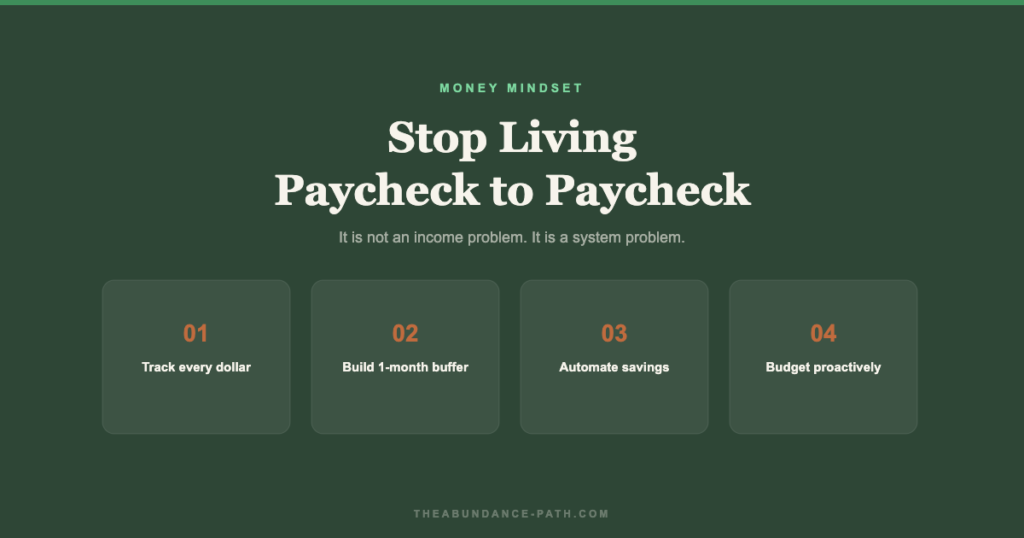
Most people who live paycheck to paycheck assume the fix is a raise.
It’s usually not. Studies consistently show that as income rises, spending rises with it. People making $100,000 a year live paycheck to paycheck too. The cycle isn’t an income problem. It’s a system problem.
Here’s how to break it.
Why It Happens (Even to High Earners)
There’s a concept called lifestyle creep. Every time income goes up, spending expands to match it. A better apartment. A newer car. More dining out. More subscriptions. More everything.
The gap between income and expenses stays the same — or gets smaller. That’s the trap.
We wrote a full breakdown of this in What Is Lifestyle Creep. It’s worth reading if you’ve ever gotten a raise and wondered where it went.
Step 1: Find Out Where the Money Actually Goes
Not where you think it goes. Where it actually goes.
Look at your last 30 days of bank and credit card statements. Categorize every transaction. This is uncomfortable. Do it anyway.
Most people find 2–3 categories that genuinely shock them. That’s where the slack is hiding.
Step 2: Build a One-Month Buffer
The paycheck-to-paycheck cycle is partly a timing problem. Bills come due before the paycheck arrives. The buffer breaks that.
Goal: save one month of expenses in a separate account. When your paycheck comes in, you’re paying this month’s bills with last month’s money. You’re always ahead instead of always catching up.
Getting to one month of buffer takes time. Start with $500. Then $1,000. Build toward the full month over 6–12 months.
Step 3: Give Every Dollar a Job Before the Month Starts
This is called zero-based budgeting. Every dollar of income gets assigned to a category — rent, groceries, debt, savings, fun — before you spend a single one.
The key word is before. Most people budget after the fact, which is just accounting. Budgeting before tells your money where to go instead of wondering where it went.
Use our free Budget Template to set this up in under 20 minutes.
Step 4: Automate Savings Before You Can Spend It
The biggest mistake people make with saving: they spend first and save what’s left. There’s never anything left.
Flip it. Set up an automatic transfer to savings the day after payday. Even $50. The amount doesn’t matter yet — the habit does. You learn to live on what remains. The savings number grows over time.
Read our guide on How to Set Up Automatic Savings for the exact steps.
Step 5: Cut One Thing You Won’t Miss
Not everything. One thing. Most people spend $50–$150/month on subscriptions they barely use. One streaming service. A gym they stopped going to. An app they forgot about.
Cancel one. Put that exact amount into savings. It’s painless money.
Step 6: Create a “No Spend” Week Once a Month
Pick one week. No restaurants. No Amazon. No impulse buys. Eat what’s in the fridge. Use what you have. That one week typically frees up $100–$200 depending on your habits.
It’s also clarifying. You realize most of the spending is habit, not need.
The Real Goal: A Gap
The paycheck-to-paycheck cycle ends when you create a consistent gap between income and expenses. That gap — even $200/month — changes everything. It’s what funds the buffer. Pays down debt. Starts the investment account.
You don’t need a raise to create a gap. You need a system. Start with the budget. Add the automation. Cut one thing. Build the buffer.
Do those four things and the cycle breaks faster than you’d expect.
Next step: track your spending every week. Our Weekly Money Check-In guide shows you how to do it in 15 minutes.
More articles
 Money Mindset
9 Money Myths That Keep the Middle Class Broke
Read → Money Mindset
How to Talk About Money With Your Partner (Without Starting a Fight)
Money is harder to talk about than sex. That’s not an exaggeration. Financial planner Douglas Boneparth, who co-authored “Money Together” with his…
Read → Money Mindset
What Is Lifestyle Creep (And How to Stop It Before It Steals Your Future)
You earn more than you did five years ago. Maybe a lot more. So why does your bank account look roughly the…
Read →