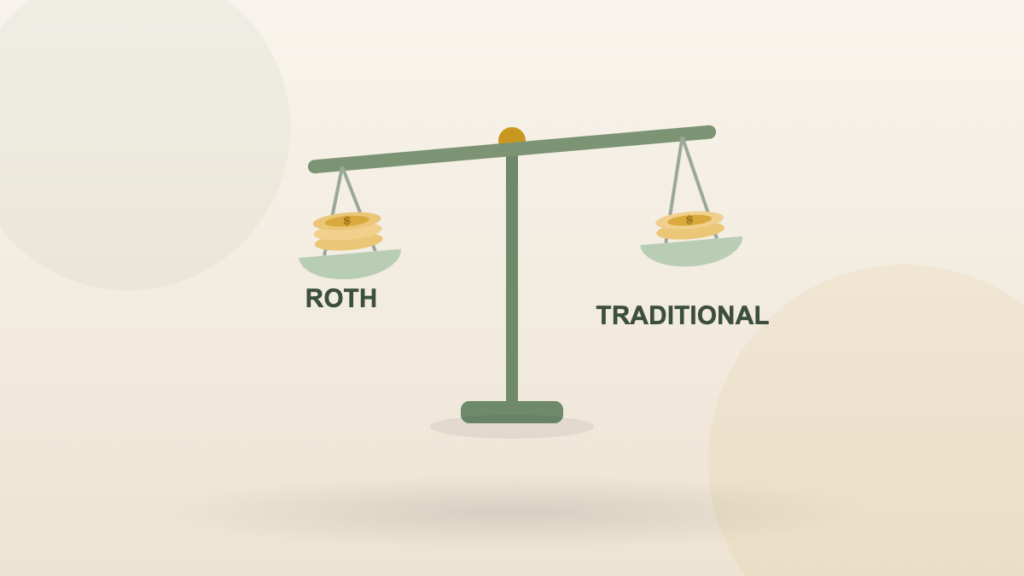
Roth IRA vs. Traditional IRA: Which One Should You Actually Pick?
When I opened my first IRA, I stared at the “Roth or Traditional?” screen for 20 minutes, Googled it, read three articles that contradicted each other, and then picked Roth because the word sounded cooler.
That’s not how you should make this decision. But honestly? For most people in their 20s and 30s, the Roth is probably the right pick anyway — just for different reasons than “it sounds cooler.”
Here’s the thing most IRA articles get wrong: they present this as a complicated tax optimization puzzle that requires a crystal ball and an accounting degree. It’s not. At its core, it’s one question with one answer based on a single variable. And once you understand it, the decision takes about 30 seconds.
Let me walk you through it.
The One-Sentence Difference
Traditional IRA: You skip paying taxes now. You pay taxes later when you withdraw in retirement.
Roth IRA: You pay taxes now. You skip paying taxes later when you withdraw in retirement.
That’s it. Same contribution limits. Same investment options. Same retirement purpose. The only difference is when Uncle Sam gets his cut.
A Real Example (Because Percentages Mean Nothing Without Dollars)
Let’s say you earn $60,000 and want to contribute $500/month ($6,000/year) to an IRA.
With a Traditional IRA: That $6,000 contribution is tax-deductible (assuming you qualify). If you’re in the 22% tax bracket, you save $1,320 on this year’s taxes. Your money grows tax-deferred for decades. But when you withdraw it in retirement, every dollar gets taxed as regular income. Pull out $40,000 in a year? That’s $40,000 of taxable income.
With a Roth IRA: That $6,000 comes from money you’ve already paid taxes on. No deduction this year. But the money grows tax-free, and when you withdraw it in retirement — every single dollar comes out tax-free. Pull out $40,000? You keep $40,000. Pull out $400,000? You keep $400,000. The IRS doesn’t touch it.
Same $6,000 investment. Same growth over time. Radically different tax treatment at the finish line.
The Decision Framework (This Is the Only Part That Matters)
Forget the calculators. Forget the “it depends on 47 variables” articles. Here’s the honest framework:
Pick Roth if you think you’ll be in a higher tax bracket in retirement than you are right now.
This usually means you’re young (in your 20s, 30s, or early 40s), your income will likely grow over your career, tax rates might increase in the future (they’re historically low right now), and you’d rather pay taxes on the seed than on the harvest.
Pick Traditional if you think you’ll be in a lower tax bracket in retirement.
This usually means you’re in your peak earning years (50s or 60s), you’re in a high tax bracket now and expect to withdraw less in retirement, or you need the tax deduction this year to reduce your current tax bill.
If you genuinely don’t know? Pick Roth. Here’s why: tax rates in the U.S. are near historical lows. The national debt is ballooning. Most financial experts believe taxes are more likely to go up in the future than down. Paying taxes now at today’s rates and never owing taxes on your retirement withdrawals is a bet that pays off in most scenarios.
Or — and this is what a lot of smart people do — split your contributions between both. Put money in a Roth IRA and contribute to a Traditional 401(k) at work. That way you’ve got tax-free money and tax-deferred money in retirement, and you can withdraw strategically to minimize your tax bill each year. Tax diversification is a real strategy, not a cop-out.
The 2026 Numbers You Need to Know
Both Roth and Traditional IRAs share the same contribution limit: $7,500 per year if you’re under 50, or $8,600 if you’re 50 or older. That limit is across both accounts combined — you can’t put $7,500 in each.
Roth IRA income limits: Single filers can make a full contribution if they earn less than $153,000. Married couples filing jointly can contribute fully if they earn less than $242,000. Earn above those thresholds and your contribution gets reduced or eliminated.
Traditional IRA income limits: Anyone with earned income can contribute regardless of how much they make. But whether your contribution is tax-deductible depends on your income and whether you have a retirement plan at work. If you have a 401(k) and earn above certain thresholds, you can still contribute — you just can’t deduct it, which reduces the main benefit.
The deadline: You can make IRA contributions for 2026 until April 15, 2027. That means you have until tax day to fund your IRA for the previous year, which gives you extra time if you’re working on building up the cash.
The Roth IRA’s Secret Superpower
There’s one feature that makes the Roth IRA genuinely special, and most people don’t know about it.
You can withdraw your contributions (not earnings) at any time, for any reason, with no penalty and no taxes.
Let me repeat that. The money you put into a Roth IRA — not the growth, just the original contributions — can come back out whenever you want, penalty-free. This makes the Roth IRA a weirdly flexible account. It’s a retirement account that can also function as a last-resort emergency backup.
Let’s say you’ve contributed $30,000 to your Roth IRA over 10 years, and it’s grown to $45,000. You can withdraw up to $30,000 (your contributions) at any time without paying taxes or penalties. The $15,000 in growth needs to stay until age 59½ to come out tax-free.
This doesn’t mean you should treat your Roth as a savings account. Please don’t. But knowing you can access your contributions in a genuine emergency makes the Roth less scary for people who worry about locking money away for 30 years.
A Traditional IRA doesn’t offer this. Early withdrawals from a Traditional IRA generally trigger income taxes plus a 10% penalty if you’re under 59½.
Where to Open One (Same Answer as Our Investing Guide)
The same three brokerages I recommend for regular investing accounts are the best for IRAs too:
Fidelity — no minimums, no fees, excellent app, great educational content. My top pick for beginners.
Schwab — no minimums, no fees, massive research library, strong customer service.
Vanguard — the original low-cost investing pioneer. Less flashy interface but rock-solid funds and philosophy.
Opening a Roth or Traditional IRA takes the same 10 minutes as opening a regular brokerage account. You’ll choose “Roth IRA” or “Traditional IRA” during signup, link your bank account, and set up automatic monthly contributions.
Once the account is open, invest in the same thing I recommended in our How to Start Investing With $50 guide: a low-cost S&P 500 index fund like VOO, FXAIX, or SWPPX. Set up automatic contributions and let compound interest do what it does.
The Mistakes I See People Make
Waiting to contribute because they can’t max it out. You don’t need $7,500. You need whatever you can afford. $100/month into a Roth IRA is infinitely better than $0/month while you wait to afford the maximum. You can always increase later.
Choosing Traditional just for the tax break without thinking long-term. Yes, the deduction feels nice in April. But that $1,320 you saved in taxes this year could cost you $10,000+ in taxes during retirement when your account is much larger. Think about the total tax bill over your lifetime, not just this year’s.
Opening an IRA and not investing the money. This happens more than you’d think. People contribute cash to their IRA and it just sits there as cash, earning almost nothing. An IRA is just an account — you have to actually buy investments inside it for the money to grow. If your IRA balance hasn’t changed since you opened it, check whether you’ve invested or just deposited.
Not contributing at all because they have a 401(k). Your 401(k) and IRA are separate accounts with separate limits. In 2026, you can contribute $24,500 to your 401(k) and $7,500 to your IRA. They’re not either/or — you can (and should) do both if you can afford it.
Ignoring the IRA entirely because “I’ll figure it out later.” Same lesson as every other investing topic: time matters more than amount. Starting a Roth IRA with $50/month at 25 builds dramatically more wealth than starting with $500/month at 45. The math is brutal and it doesn’t negotiate.
The 30-Second Decision Tree
If all of that felt like a lot, here’s the cheat sheet:
Are you under 40 with a growing income? → Roth IRA.
Are you over 50 in your peak earning years? → Traditional IRA (or at least a mix).
Do you earn less than $153K single or $242K married? → You’re eligible for a Roth. Use it.
Do you earn too much for a Roth? → Contribute to a Traditional IRA, or look into a backdoor Roth conversion (your brokerage can walk you through it).
Do you already have a Traditional 401(k) at work? → Open a Roth IRA to add tax diversification.
Are you completely stuck and can’t decide? → Open a Roth IRA. For most people, most of the time, it’s the right call.
Open It This Week
You already know the difference. You already know which one fits your situation. The only thing left is the 10 minutes to open the account and the first automatic transfer.
A Roth IRA is one of the most powerful wealth-building tools available to regular people. Tax-free growth for decades. Tax-free withdrawals in retirement. Penalty-free access to your contributions if life goes sideways. No other account offers all three.
And unlike your 401(k), nobody at work is going to set this up for you. There’s no orientation meeting. No HR form. No checkbox. You have to do it yourself.
But it takes 10 minutes. And 30 years from now, when you’re pulling tax-free income from an account you started with $100/month, you’ll understand why everyone who knows about this won’t shut up about it.
Go open the account.
Related Posts on The Abundance Path
401(k) Explained Like You’re 5. How to Start Investing With $50. How to Set Up Automatic Savings. The 50/30/20 Budget Rule: A Complete Guide. 7 Money Mistakes the Middle Class Keeps Making. How to Build a $5,000 Emergency Fund.
Know someone who’s been meaning to open an IRA for three years? Send them this. Follow The Abundance Path for weekly investing tips and financial advice you can actually understand.
Disclaimer: This is educational content, not tax or financial advice. IRA rules, contribution limits, and income thresholds are based on 2026 IRS guidelines and may change. Tax implications vary by individual. Consult a tax professional or financial advisor for decisions specific to your situation.
New to investing? Start with our complete walkthrough: How to Start Investing: A Beginner’s Guide to Build Real Wealth.