You trade hours for money. Most of us do.
You work, you get paid. You stop working, the money stops. It’s a treadmill — and you can never step off, because the bills never stop either.
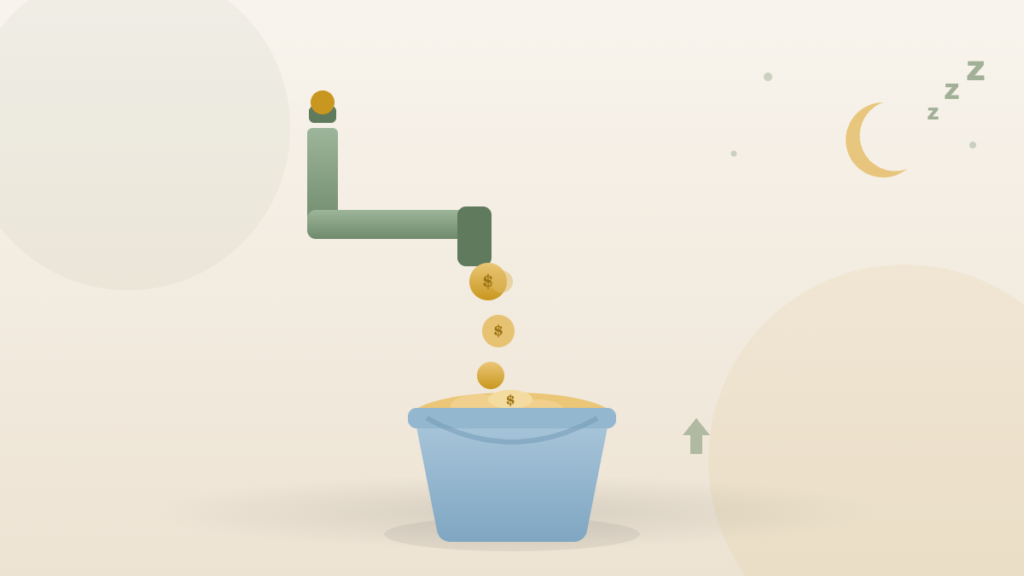
What if some of your money came in without the hours? While you ran errands. While you slept.
That’s passive income. And no, it’s not a scam or a fantasy reserved for the rich. It’s real, it’s doable on a normal income, and you can start small this month.
This is your honest, no-hype guide to passive income for beginners. What it really is, what actually works, and how to start.
What Passive Income Actually Is
Let’s clear up the biggest myth first. Passive income is not “no work.”
It’s work you do once that keeps paying you. You put in effort or money upfront. Then it earns for you again and again, long after the work is done.
Think of it like planting a tree. You dig, plant, and water at the start. Later, it gives fruit every season without you doing much at all.
So forget the ads promising money for nothing. Real passive income takes a real push at the beginning. The magic is that the push pays off for years.
Why It’s Worth the Effort
One income stream is fragile. Lose your job, and it all stops.
Passive income breaks that fear. It adds streams that don’t depend on you clocking in. Even a small one — an extra $200 a month — changes things. It covers a bill. It speeds up your debt payoff. It gets invested and grows.
Do it long enough, and the dream becomes real: your money earns more than you spend, and work becomes a choice instead of a cage.
Passive Income That Actually Works for Beginners
Ignore the hype streams. Here are the real ones, split by what you start with — money or time.
If You Have a Little Money to Start
Dividend stocks and funds. Some investments pay you cash just for owning them. Buy shares, collect payments every few months — no work after the buy. Start here: Dividend Investing for Beginners.
Index funds that grow. Not “income” you withdraw yet, but your money compounds while you sleep — the purest passive growth there is. New to it? Read How to Start Investing and see what $100/month becomes over 20 years.
High-yield savings. The simplest passive income on earth. Park cash in a high-yield account and it pays you interest for doing nothing. Details in our guide to saving money.
If You Have More Time Than Money
Digital products. Make something once, sell it forever. Printables, templates, an ebook, a budgeting spreadsheet, a small online course. You build it once; it sells while you sleep.
Content that earns. A blog, a YouTube channel, a niche site. It’s slow to start, but content keeps drawing traffic — and ad or sponsor money — for years after you hit publish.
Affiliate income. Recommend products you genuinely use, earn a commission when people buy through your link. Pairs perfectly with a blog or channel.
Print-on-demand. Upload a design once. A company prints it on mugs or shirts and ships each order. You never touch inventory.
How Much Can You Really Make?
Time for honesty. Passive income starts slow. Painfully slow.
Your first month might earn a few dollars. That’s normal. It’s not failure — it’s the planting stage.
But it compounds. The dividend pot grows as you add to it. The blog post you wrote a year ago still earns today. Streams stack on streams.
Realistic path: months of small numbers, then a slow climb, then — for those who don’t quit — real money. Anyone promising fast riches is selling something. Walk away.
How to Actually Start This Month
The mistake beginners make is trying ten things at once. Don’t. Pick one.
Choose based on what you have more of:
- More money than time? Open a brokerage or high-yield account and start with dividends or index funds. Quietest, most reliable start.
- More time than money? Pick one digital product or one content platform. Build it. Stick with it.
Then go deep on that one thing for a few months before adding another. Focus beats scatter every time.
And fund it the smart way. Free up cash first with a solid budget, then point that money at your first stream.
Scams and Traps to Avoid
- “Earn $5,000/week on autopilot!” If it sounds too good to be true, it is. Always.
- Courses that only teach you to sell the course. Pyramid logic. Skip.
- Anything needing big money “to unlock returns.” Real passive income doesn’t demand huge upfront fees.
- Quitting in month one. The most common trap. The slow start is where almost everyone gives up — right before it works.
When in doubt, check it out. The FTC keeps a free, plain-English resource on spotting money scams at consumer.ftc.gov.
Active Income vs. Passive Income
It helps to see the difference clearly.
Active income is trading time for money. Your job, a side gig, freelancing. You stop, the money stops. It’s the foundation — but it has a ceiling, because you only have so many hours.
Passive income is money that keeps coming after the work is done. It has no hour-for-hour ceiling. One blog post or one dividend stock can pay you a thousand times.
You need active income first — it funds everything. But the goal is to slowly turn some of that active money into passive streams. Earn, then make the earnings earn.
More Passive Income Ideas to Grow Into
Once your first stream is running, here are bigger ones to explore later.
Real estate (the hands-off way). You don’t need to be a landlord. REITs let you invest in real estate like a stock and collect rental-style income — no tenants, no toilets. A simple entry point into property income.
Royalties. Write a book, license a photo, record a piece of music. Each sale or use pays you again. Create once, earn for years.
Rent what you already own. A spare room, a parking spot, camera gear, tools. Idle stuff can quietly earn while you keep ownership.
Peer-to-peer and interest. Lending platforms and high-yield accounts pay you for letting your money sit and work. Lower effort, lower returns — but truly hands-off.
Don’t chase all of these. Just know the menu is big. You only need one or two to work.
The Real Secret: Reinvest
Here’s where beginners leave money on the table. They spend their first passive earnings.
Don’t. In the early years, feed it back in.
Dividends? Reinvest them to buy more shares — which pay more dividends. Earned $50 from a digital product? Use it to make your next one. This is how small streams snowball into big ones.
The same compounding that grows dividends works on every stream. Reinvested earnings are seeds. Spent earnings are gone. Plant them, and the whole thing accelerates.
What Year One Actually Looks Like
Set your expectations right and you won’t quit.
Months 1–3: You build. You earn almost nothing. This is normal — you’re planting. Most people quit here. Don’t.
Months 4–8: Small trickles. A few dollars in dividends, a couple of product sales, the first ad cents. Tiny, but real. Proof it works.
Months 9–12: The trickle grows. Your stream has history now — more shares, more content, more customers. The numbers start to mean something.
Year one is about building the machine, not getting paid by it. The payoff lives in years two, three, and beyond. Patience is the whole game.
The Mindset That Makes It Work
Passive income rewards the patient and punishes the impatient. That’s it.
Treat it like planting, not gambling. Expect slow. Celebrate small. Keep showing up after the excitement fades — because that’s exactly when most people stop, and exactly when it starts to pay.
And remember to fund it without going broke. Keep your spending in check and your savings flowing first, using your money-saving system, so you always have a little to plant.
Don’t Forget About Taxes
Passive income is still income. The tax office wants its share.
This trips up beginners who spend every dollar, then get a surprise bill. Avoid it with one simple habit: set aside a portion of every passive dollar for taxes from day one.
Different streams are taxed differently. Dividends, interest, and royalties each have their own rules, and they can shift year to year. When your income grows past pocket change, it’s worth a quick chat with a tax professional. A small fee there can save you a big headache later.
You don’t need to master tax law today. Just don’t ignore it. Save a slice, keep simple records, and you’ll stay out of trouble.
How Many Streams Do You Really Need?
You’ve heard “millionaires have seven income streams.” It’s a catchy line, not a rule.
You do not need seven. You need one that works — then a second, then maybe a third. Quality beats quantity every time.
Three solid, growing streams will do more for you than ten half-built ones you can’t keep up with. Spreading too thin means none of them ever gets the attention to actually take off.
So start with one. Make it real. Only add another once the first runs without much from you. Slowly, deliberately, you build a small portfolio of income that doesn’t depend on your time — and that’s true financial freedom.
A Simple Example to Make It Real
Let’s put numbers to it. Say you save $200 a month and put it into dividend funds.
Year one feels pointless — a few dollars in payouts. But you keep going. You keep adding $200, and you reinvest every dividend.
Fast-forward several years. That pot is now thousands of dollars, throwing off real income every quarter — money you never worked an extra hour for. Meanwhile the same habit, aimed at a digital product or a blog, could be earning alongside it.
None of this needed a windfall. Just $200 a month, patience, and reinvesting. That’s the whole secret hiding behind every “earn while you sleep” headline.
Your First Move
Don’t overthink it. This week:
- Pick ONE stream — money-based or time-based.
- Take the first concrete step: open the account, or outline the product.
- Put a small amount of money or one hour a week into it.
- Commit to sticking with it for 90 days before judging it.
That’s how every passive income story starts. Not with a windfall — with one small, deliberate beginning.
The goal isn’t to get rich overnight. It’s to slowly build money that doesn’t need your hours. Stream by stream, you buy back your time.
Small steps. Smart money. Big life. Plant your first stream today.
More articles
 Make Money
How to Make Extra Money From Home: 12 Real Ways That Actually Pay
These 12 ways to make extra money from home are real — not surveys for $2/hour. Pick one, give it 90 days, and see what happens.
Read → Make Money
Side Hustles That Realistically Make $500 a Month (Without Quitting Your Job)
Not every side hustle works. These ones actually hit $500/month for real people working nights and weekends around a full-time job.
Read → Make Money
Passive Income Ideas That Actually Pay You While You Sleep
These passive income ideas actually pay you while you sleep. Real options, honest effort levels, and how to start with what you have now.
Read →