Most people budget by tracking what they spent. Zero-based budgeting flips that entirely.
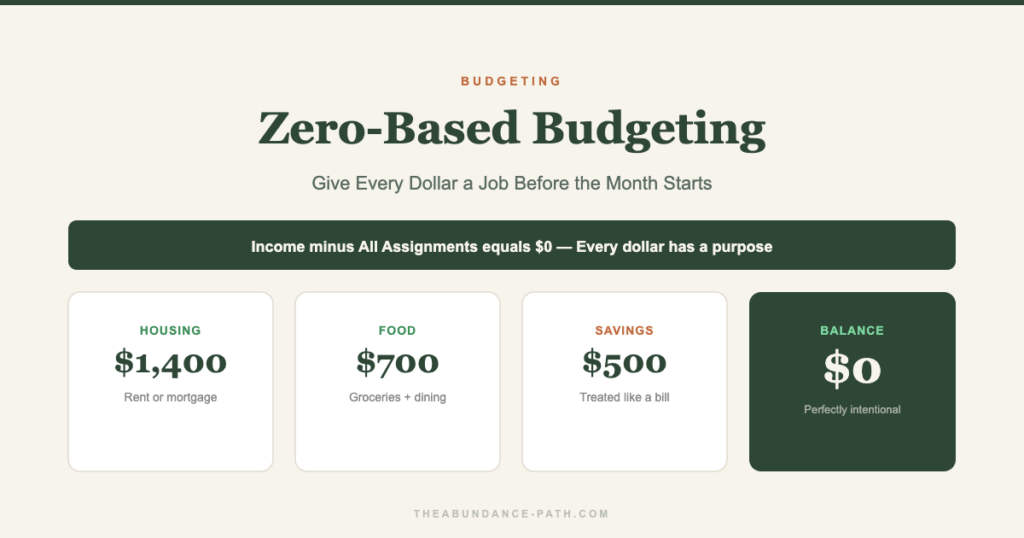
Instead of looking back, you look forward. Before the month begins, you assign every dollar of expected income to a specific category. When you’re done, income minus all assignments equals zero.
Zero doesn’t mean broke. It means intentional. Every dollar has a job.
Why Zero-Based Budgeting Works
The reason most budgets fail is vagueness. “I’ll spend less on food this month” isn’t a plan. “I’m allocating $600 for groceries and $150 for dining out” is a plan.
Zero-based budgeting forces specificity. You have to decide what matters before the money arrives — not after it’s already spent.
It also eliminates the “where did it all go?” mystery at the end of the month. You know exactly where it went because you told it where to go.
How to Set It Up: Step by Step
Step 1: Calculate your monthly take-home income. This is after taxes, after retirement contributions, after everything. What actually hits your bank account? Use the lowest month if your income varies.
Step 2: List your fixed expenses. Rent or mortgage, car payment, insurance, subscriptions, loan minimums. These are the same every month. Write them down and total them.
Step 3: Estimate variable expenses. Groceries, gas, utilities, dining out, clothing, entertainment. Look at last month’s actual spending as a starting point. Be honest.
Step 4: Include savings and debt payoff as line items. This is where most budgets fail — they treat savings as an afterthought. In zero-based budgeting, savings is a category just like rent. Assign it first, not last.
Step 5: Subtract everything from income until you hit zero. If you go negative, cut something. If you have money left over, assign it — more to savings, extra to debt, or a fun category. Just don’t leave it unassigned.
A Simple Example
Monthly take-home: $4,500
- Rent: $1,400
- Car + insurance: $550
- Groceries: $500
- Utilities: $180
- Gas: $120
- Dining out: $200
- Subscriptions: $80
- Kids/school: $150
- Emergency fund: $200
- Debt payoff (extra): $300
- Personal spending: $200
- Clothing/misc: $120
- Remaining assigned to fun savings: $500
Total: $4,500. Balance: $0. Every dollar has a job.
What Happens Mid-Month When Things Change?
Life happens. The car needs a repair. You spent more on groceries than planned. That’s fine — you adjust.
Pull money from another category. Dining out budget takes the hit instead of savings. The total always stays at zero. This is called “rolling with the punches” in budgeting language.
The key is making the adjustment consciously — not just spending and hoping it works out.
Tools to Make It Easier
YNAB (You Need A Budget): Built specifically for zero-based budgeting. Powerful, syncs with bank accounts, and has a strong learning community. Costs $14.99/month after trial.
Spreadsheet: Our free Budget Template is designed for zero-based budgeting with income, fixed expenses, variable expenses, and savings all in one view.
Paper: Genuinely works. Write income at the top. Subtract categories until you hit zero. Some people find the physical act of writing reinforces the commitment.
The First Month Is the Hardest
You’ll under-budget some categories and over-budget others. That’s normal. Month two is better. Month three starts to feel automatic.
The people who succeed at zero-based budgeting aren’t more disciplined than average. They just stopped leaving their money directionless.
Give every dollar a job. Then watch what happens to your account balance at the end of the month.
New to budgeting? Start with our stress-free beginner’s guide, then come back to zero-based budgeting once you have the basics down.
More articles
 Budget
The 50/30/20 Budget Rule: A Complete Guide for 2026
There’s a reason the 50/30/20 rule is the most recommended budgeting method on the planet. It works. Not because it’s complicated, but…
Read → Budget
How to Budget: The Stress-Free Beginner’s Guide to Finally Take Control of Your Money
Read → Budget
Budgeting Mistakes That Quietly Drain Your Bank Account Every Month
It’s the end of the month. You check your balance. And there it is again — that sinking feeling. Where did all…
Read →