

Your paycheck hits your account. For a brief, beautiful moment, you feel rich. Then rent comes out. Then the car payment. Then groceries, utilities, subscriptions, gas, and that thing you ordered at midnight because Instagram convinced you that you needed it.
Three days later, you’re checking your balance and wondering how $4,500 turned into $347 without you noticing.
Sound familiar? You’re not alone. A 2026 survey found that the majority of Americans feel visible improvement in their financial stress within 30 to 60 days of starting a real budget, but most never start one because they don’t know where each dollar should actually go.
That’s what this guide is for. Not theory. Not motivational platitudes about “spending less.” A concrete, dollar-by-dollar breakdown of exactly where your paycheck should go, based on your actual take-home pay, with templates you can use starting with your very next paycheck.
Think of this as the instruction manual your money never came with.
Step 1: Know Your Real Number
Everything starts with your after-tax take-home pay, not your salary, not your hourly rate, not what your offer letter says. Your actual net income is the amount deposited into your bank account after federal taxes, state taxes, Social Security, Medicare, and any other deductions.
Check your most recent pay stub or bank deposit. That’s your number.
If your employer deducts health insurance premiums or 401(k) contributions before your paycheck reaches you, add those amounts back in for budgeting purposes. Health insurance is a “need” and 401(k) contributions are “savings,” so they need to be included in your total income for the percentages to work correctly.
If you have irregular income from freelancing, tips, or side hustles, use the average of your last three months as your baseline. Budget conservatively based on this average, and treat any month that exceeds it as bonus money for savings or debt.
Step 2: The Paycheck Allocation Framework
We recommend the 50/30/20 framework as your foundation, with one important addition: a priority order that tells you exactly what gets funded first. The percentages tell you how much goes where. The priority order tells you what to fund when money is tight.
Here’s the complete paycheck allocation, in the order your money should be assigned.
Priority 1: Cover Your Needs (50% of Take-Home Pay)
Your needs are the non-negotiable expenses that keep your life functioning. Fund these first, before anything else.
Housing takes the largest share. Rent or mortgage payment, property taxes, homeowner’s or renter’s insurance. This should ideally stay below 28 percent of your gross income, though in high-cost areas, 30 to 35 percent of take-home pay is common.
Utilities come next. Electricity, gas, water, sewer, trash, and basic internet service. In 2026, basic internet is a need for most households since work, school, and essential services depend on it.
Groceries cover basic food for your household. Not dining out, not specialty items, not the premium organic everything. Basic nutrition that feeds your family.
Transportation includes your car payment, car insurance, gasoline, parking, tolls, and basic maintenance, or your public transit pass if you don’t drive.
Insurance covers health insurance premiums (if not deducted from your paycheck), plus any required insurance like auto or renters insurance.
Minimum debt payments are the minimum required payments on credit cards, student loans, car loans, and any other debts. Only the minimums go here. Extra payments belong in the 20 percent savings category.
Childcare required for work, basic phone service, and essential medical expenses also fall in this category.
Priority 2: Pay Yourself (20% of Take-Home Pay)
This is the money that builds your future. Fund this second, before your wants.
Here’s the exact priority order within this 20 percent.
First: Emergency fund. If you don’t have at least $1,000 saved, every available dollar in this category goes here until you do. Then keep building toward $5,000 and eventually three to six months of essential expenses. See our guide to Building a $5,000 Emergency Fund.
Second: Employer 401(k) match. If your employer offers a match, contribute at least enough to capture the full match. This is an instant 50 to 100 percent return on your money. If your employer deducts this from your paycheck pre-tax, it’s already being handled, but make sure you’re contributing enough to get the full match.
Third: High-interest debt payoff. Any extra payments toward credit card debt or other high-interest debt (above 10 percent APR) go here. Use the debt snowball or debt avalanche method from our comparison guide.
Fourth: Additional retirement savings. Once your emergency fund is solid and high-interest debt is gone, increase retirement contributions toward 15 percent of your income.
Fifth: Other savings goals. House down payment, car replacement fund, vacation fund, college savings, or taxable investment accounts.
Priority 3: Enjoy Your Life (30% of Take-Home Pay)
This is your quality-of-life spending. Fund this last, after needs and savings are covered.
Dining out and takeout. Restaurants, coffee shops, delivery apps, and any food that isn’t basic groceries.
Entertainment. Streaming services, movies, concerts, sporting events, books, games, and hobbies.
Shopping. Clothing beyond basic needs, home décor, gadgets, electronics, and personal items.
Personal care. Haircuts, gym memberships, spa services, and grooming products beyond basics.
Travel and experiences. Weekend trips, vacations, and anything you do purely for enjoyment.
Subscriptions. Any subscription that isn’t essential for work or daily life.
The 30 percent for wants isn’t a minimum to spend. It’s a maximum. Some months you’ll spend 20 percent on wants, and the extra 10 percent can flow to savings. The category exists to give you permission to enjoy life without guilt, while ensuring your needs and future are funded first.
Step 3: Real Paycheck Breakdowns at Every Income Level
Theory is great. Real numbers are better. Here’s exactly how the framework looks at three common income levels.
Example 1: $3,000/Month Take-Home
This is roughly a $43,000 annual salary. Money is tight at this level, and every dollar needs a clear purpose.
Needs (50%) = $1,500. Housing at $900 (this might require a roommate in many cities). Utilities at $120. Groceries at $250. Transportation at $130. Insurance at $50. Minimum debt payments at $50.
Savings (20%) = $600. Emergency fund contribution at $200. 401(k) contribution at $200 (enough to capture employer match). Extra debt payment at $200.
Wants (30%) = $900. Dining out at $150. Entertainment and streaming at $100. Shopping and personal care at $150. Fun money and miscellaneous at $500.
If $900 for wants feels like a lot while your savings are only $600, consider shifting to a 50/25/25 split temporarily, directing an extra $150 per month to savings. That extra $150 adds $1,800 per year to your financial foundation.
Example 2: $4,500/Month Take-Home
This is roughly a $65,000 annual salary. The 50/30/20 rule fits most naturally at this income level.
Needs (50%) = $2,250. Housing at $1,200. Utilities at $160. Groceries at $400. Transportation at $250. Insurance at $100. Minimum debt payments at $140.
Savings (20%) = $900. Emergency fund at $250. 401(k) at $350. Extra debt payment at $200. Sinking funds (car repair, holiday, annual expenses) at $100.
Wants (30%) = $1,350. Dining out at $250. Entertainment at $150. Shopping at $200. Personal care at $100. Travel savings at $200. Miscellaneous fun at $450.
At this income, $900 per month in savings builds to $10,800 per year. Invested at 8 percent average returns, that’s over $157,000 in ten years.
Example 3: $6,000/Month Take-Home
This is roughly a $90,000 annual salary. At this level, you have the opportunity to accelerate your financial goals significantly.
Needs (50%) = $3,000. Housing at $1,600. Utilities at $200. Groceries at $500. Transportation at $350. Insurance at $150. Minimum debt payments at $200.
Savings (20%) = $1,200. Emergency fund at $300. 401(k) at $500. Extra debt payment or investment at $300. Sinking funds at $100.
Wants (30%) = $1,800. Dining out at $350. Entertainment at $200. Shopping at $300. Personal care at $150. Travel savings at $300. Miscellaneous fun at $500.
At this income, consider shifting to 50/25/25 or even 40/25/35 to accelerate wealth building. An extra $300 per month invested for 20 years at 8 percent returns adds approximately $176,000 to your net worth.
Step 4: The Paycheck-by-Paycheck Method (For Biweekly Pay)
If you’re paid biweekly (every two weeks), you get 26 paychecks per year, not 24. That means 10 months you get two paychecks, and two months you get three. Those two extra paychecks are a built-in wealth-building opportunity.
Here’s how to budget biweekly. Take your monthly budget and divide each category by two. That’s your per-paycheck allocation. On Paycheck 1, cover your first-half-of-month bills: rent, some utilities, and half your savings transfer. On Paycheck 2, cover your second-half bills: remaining utilities, groceries, insurance, and the other half of your savings transfer.
The two “bonus” paychecks each year (the months where you get three checks instead of two) should go entirely to your highest-priority financial goal: emergency fund, debt payoff, or investments. That’s two full paychecks, potentially $2,000 to $5,000, that can supercharge your progress without changing your monthly budget at all.
Many people don’t even realize they get these bonus checks because the money gets absorbed into regular spending. By budgeting based on two paychecks per month, the third paycheck becomes pure financial acceleration.
Step 5: The Sinking Fund Strategy (The Budget Hack Nobody Talks About)
The most common reason budgets fail isn’t daily spending. It’s the irregular expenses that ambush you every few months. Car registration. Holiday gifts. Annual insurance premiums. Back-to-school shopping. Home repairs. Birthday parties. Vet bills.
These expenses aren’t emergencies. They’re predictable. You know they’re coming. But if you don’t budget for them monthly, they feel like emergencies when they arrive, and they blow up your budget every time.
The fix is sinking funds. A sinking fund is money you set aside each month for a specific future expense. You break the annual cost into 12 monthly contributions and save for it gradually, so when the bill arrives, the money is already there.
Here’s how to set them up. List every non-monthly expense you’ll have this year: car registration, holiday gifts, annual subscriptions, home maintenance, medical expenses, clothing replacements, birthday and event gifts, and anything else that doesn’t come every month but happens predictably. Add up the annual total for each category. Divide each by 12 to get your monthly sinking fund contribution.
For example, if you spend $600 on holiday gifts, $400 on car maintenance, $200 on birthday gifts, and $300 on annual subscriptions, that’s $1,500 per year, or $125 per month. Add $125 to your monthly budget as a sinking fund line item, transfer it to a savings sub-account each month, and when December arrives, the gift money is already there.
Some high-yield savings accounts like Ally let you create multiple “buckets” within a single account, making it easy to track different sinking funds without opening multiple accounts.
Step 6: Automate the Entire System
The final step is to remove yourself from the process as much as possible. The less you have to think about, decide on, or remember, the more consistently your budget will work.
On payday, automate these transfers immediately. Set up automatic transfers for your emergency fund contribution, your sinking fund contribution, and any additional savings goals. Schedule these for the day after your paycheck deposits.
Automate all fixed bills. Set up autopay for rent or mortgage, utilities, insurance, car payment, minimum debt payments, and any other fixed bills. This eliminates late fees and removes these decisions from your mental workload.
Automate your retirement contributions. If your employer offers a 401(k), set your contribution percentage and forget it. Increase it by 1 percent every time you get a raise.
What’s left is your spending money. After all automated transfers and bills are handled, the remaining balance in your checking account is your money for groceries, dining out, entertainment, shopping, and daily life. This is your real-time spending budget. When it’s gone, you wait for the next paycheck.
This “pay yourself first, automate everything, spend what’s left” approach is the most reliable budgeting system ever designed. It works because it doesn’t require daily discipline or constant tracking. The important money moves happen automatically, and your day-to-day spending is naturally constrained to whatever remains.
Your Free Paycheck Budget Template
Copy this template into a notebook, spreadsheet, or notes app and fill it in with your numbers.
My Monthly Take-Home Pay: $_______________
NEEDS (50% = $______) Housing (rent/mortgage): $______ Utilities: $______ Groceries: $______ Transportation: $______ Insurance: $______ Minimum debt payments: $______ Childcare: $______ Other essentials: $______ Total needs: $______
SAVINGS (20% = $______) Emergency fund: $______ 401(k)/retirement: $______ Extra debt payments: $______ Sinking funds: $______ Other savings goals: $______ Total savings: $______
WANTS (30% = $______) Dining out: $______ Entertainment/streaming: $______ Shopping: $______ Personal care: $______ Travel fund: $______ Hobbies: $______ Miscellaneous fun: $______ Total wants: $______
VERIFICATION Total needs + savings + wants = $______ Does this equal my take-home pay? YES / NO If no, adjust until balanced.
What to Do When Your Needs Exceed 50 Percent
For many Americans, especially in high-cost cities, keeping needs to 50 percent feels impossible. If housing alone takes 35 to 40 percent of your income, the standard 50/30/20 split won’t work.
Here are adjusted frameworks based on your situation.
Needs at 60 percent. Use a 60/20/20 split. Your wants drop to 20 percent, but your savings rate stays protected. This is the most common adjustment and works well for most people in expensive areas.
Needs at 70 percent. Use a 70/15/15 split. This is a survival budget. Your immediate priority should be finding ways to reduce needs (cheaper housing, lower car payment, switching insurance providers) or increase income.
Needs at 50 percent but heavy debt. Use a 50/20/30 split where 30 percent goes to savings and debt and only 20 percent to wants. Once the debt is cleared, return to the standard 50/30/20.
The critical principle across all adjustments: never drop savings below 10 percent unless you’re facing a genuine financial emergency. Even 10 percent saved consistently builds a meaningful safety net over time.
Common Paycheck Budgeting Mistakes
Budgeting with gross income instead of net. Your budget must be based on what actually hits your bank account, not your salary. Using gross income makes every category feel impossible because you’re budgeting with money you never receive.
Not accounting for irregular expenses. Without sinking funds, “surprise” expenses blow up your budget multiple times per year. They’re not surprises if they happen every year.
Setting it and forgetting it permanently. Your budget should be reviewed quarterly and adjusted whenever your income, expenses, or goals change. A raise, a new apartment, a paid-off debt, all of these change your numbers.
Making the budget too detailed. If you have 30 categories, you’ll stop tracking within a week. The 50/30/20 framework works because it has three categories. Keep it simple.
Not including personal spending money. Both partners in a couple (and even individuals) need a reasonable amount of no-questions-asked spending money. Without it, the budget feels like a prison, and you’ll eventually break out.
Frequently Asked Questions
Q: Should I budget monthly or per paycheck?
Either works, but per-paycheck budgeting is often easier for people paid biweekly because it aligns your budget with when money actually arrives. The key is consistency, whichever method you choose.
Q: What if my income changes every month?
Budget based on your lowest expected monthly income from the past three to six months. In months when you earn more than that baseline, direct the entire surplus to savings or debt repayment. This keeps your spending stable even when your income fluctuates.
Q: Where do annual subscriptions go?
Into sinking funds. If you pay $120 per year for a subscription, budget $10 per month into your sinking fund. When the annual charge hits, the money is waiting. Don’t let annual charges show up as “emergencies.”
Q: How do I handle my partner wanting to spend more than the budget allows?
This is a communication issue, not a math issue. See our guide on How to Talk About Money With Your Partner. The short answer: both partners need input on the budget, both need personal spending money, and both need to agree on shared financial goals.
Q: I’ve never budgeted before. Where do I start?
Start by tracking your spending for one full month without changing anything. Just observe. Then compare your actual spending to the 50/30/20 targets. The gaps between your current spending and the targets will show you exactly where to focus. Use a free budgeting app from our Best Free Budgeting Apps guide to make tracking easy.
Your Next Paycheck Starts Now
You don’t need to wait until the first of the month or the start of a new year. Your next paycheck is your fresh start.
Before that paycheck hits your account, fill out the template above. Set up your automatic transfers. Automate your bills. Know your three numbers: needs, savings, wants.
When the money lands, it already has a plan. No guessing, no wondering, no end-of-month panic. Just a system that runs itself and builds your financial future one paycheck at a time.
The first paycheck you budget intentionally is the paycheck that changes everything.
Related Posts on The Abundance Path
The 50/30/20 Budget Rule: A Complete Guide for 2026. Best Free Budgeting Apps Ranked for 2026. How to Build a $5,000 Emergency Fund Starting From Zero. 7 Money Mistakes the Middle Class Keeps Making. 10 Monthly Bills You’re Overpaying (And How to Cut Them Today). How to Save $1,000 in 30 Days on a Middle-Class Income. Weekly Money Check-In: How to Review Your Finances in 15 Minutes. Debt Snowball vs. Debt Avalanche: Which Actually Works?
Did you find this guide helpful? Share it with someone who needs a clear plan for their next paycheck. Follow The Abundance Path for weekly budgeting tips and practical financial advice for middle-class families.
Disclaimer: This article is for informational purposes only and does not constitute financial advice. Income examples are approximate and vary by location, tax situation, and individual circumstances.
Paycheck planning works best inside a bigger plan. Start with our complete beginner’s guide to budgeting.
More articles
 Budget
How I Budget With Irregular Income (A System That Actually Works)
Most budgeting advice assumes one thing: that the same amount of money shows up in your bank account at the same time…
Read → Budget
Grocery Budget Hacks: How We Cut Our Food Bill by $400/Month Without Eating Ramen Every Night.
Read →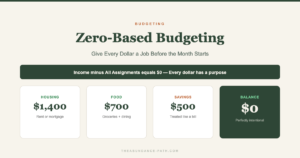 Budget
Zero-Based Budgeting: How to Give Every Dollar a Job
Zero-based budgeting means every dollar has a purpose before the month starts. It sounds rigid. It's actually the most freeing way to handle money.
Read →