

Most budgeting advice assumes one thing: that the same amount of money shows up in your bank account at the same time every month.
If you’re a freelancer, gig worker, commission-based salesperson, seasonal worker, small business owner, or anyone else whose income changes from month to month, that advice is useless. You can’t allocate $2,500 to needs when you don’t know if this month’s income will be $2,000 or $6,000. You can’t set up automatic transfers for a fixed amount when the money doesn’t arrive in fixed amounts.
And you’re not alone. The independent workforce in the U.S. has grown to over 70 million people according to recent Upwork and MBO Partners studies. That’s nearly half the working population whose income doesn’t come in neat biweekly packages. Yet the vast majority of budgeting tools, apps, and advice are designed for salaried employees.
After years of freelancing with income that swung from $2,800 to $9,500 in any given month, I built a system that creates stability from chaos. It’s not complicated. It doesn’t require a finance degree. And it works regardless of whether this month is a feast or a famine.
Here’s the complete system.
Step 1: Find Your Floor (Your Survival Number)
Most people budget based on their average income. That’s a mistake when your income is irregular. Averages smooth out the very volatility that makes budgeting hard. Your average might be $5,000 per month, but if three months this year will be $2,800, budgeting for $5,000 those months means going into debt.
Instead, budget based on your floor: the lowest monthly income you’ve earned in the past 12 months.
Pull up your bank records for the last 12 months. Find the worst month. That’s your budgeting baseline, not the average, not the median, the lowest number. If your worst month was $3,200, that’s the income you build your budget around.
This feels conservative, and it is. That’s the point. By building your spending around your worst month, you guarantee that you can cover your essentials even during your slowest period. Every month that earns more than the floor becomes an opportunity to save, invest, or pay off debt, not a license to spend more.
Step 2: Build Your Floor Budget (Essentials Only)
Using your floor income number, create a bare-bones budget that covers only your absolute essentials.
Housing. Rent or mortgage, renter’s or homeowner’s insurance.
Utilities. Electricity, gas, water, basic internet, phone.
Food. Basic groceries. Not dining out, not delivery, not premium brands. Survival-level grocery spending. See our Grocery Budget Hacks for strategies to keep this number low.
Transportation. Car payment, insurance, gas, or transit pass. The minimum needed to get to work.
Insurance. Health insurance if self-paid. Any other required insurance.
Minimum debt payments. The absolute minimum on every debt. Not extra payments, just the minimums.
Taxes. This is critical for self-employed workers. Set aside 25 to 30 percent of every payment for taxes (more in high-tax states). Open a separate savings account labeled “Taxes” and never touch it for anything else.
Add these up. This is your floor budget, the minimum amount you need each month to keep your life running. Everything else is funded only after these essentials are covered.
Step 3: Pay Yourself a Salary
This is the game-changer. Instead of spending money as it arrives in unpredictable bursts, create an artificial paycheck that smooths out your income.
Here’s how it works. All your income, from every source, goes into a single “income holding” account. This can be a business checking account, a separate personal checking account, or any account that you don’t spend from daily. On the 1st and 15th of each month (or whatever schedule you choose), you transfer a fixed amount from the holding account to your personal spending account. This fixed transfer is your “salary.”
Your salary amount should be your floor budget number plus a small buffer for basic wants, roughly 10 to 20 percent above your floor.
For example, if your floor budget (essentials only) is $3,200, your self-paid salary might be $3,700. That extra $500 covers some dining out, entertainment, and basic quality-of-life spending without putting you at risk during slow months.
Everything above your salary stays in the income holding account. Over time, this account accumulates a buffer that absorbs the volatility of your income. Good months fill it up. Slow months draw it down. But your personal spending stays constant regardless of what’s happening with your clients or gigs.
The first couple of months feel strange because the holding account fills up while your spending account looks the same as always. That’s exactly the result you want. You’ve built a wall between your clients’ unpredictable payment habits and your personal financial stability.
Step 4: Create a Priority Waterfall for Surplus Income
In months when your income exceeds your salary, you’ll have surplus money sitting in your holding account. This is where wealth gets built, but only if you direct it intentionally.
Use this priority order for every surplus dollar.
Priority 1: Tax savings. Make sure your tax savings account has at least 25 to 30 percent of your year-to-date gross income set aside. Self-employed quarterly estimated taxes are due in April, June, September, and January. Missing these deadlines costs you penalties on top of a larger April bill.
Priority 2: Emergency fund. Build toward six months of essential expenses, not three. Standard advice recommends three to six months, but for irregular earners, six months is the floor. Your income varies more than a salaried worker’s, so your reserve needs to absorb more variation. See our guide to Building a $5,000 Emergency Fund to get started.
Priority 3: Income buffer. Continue building your income holding account until it holds two to three months of your salary. This buffer is what keeps your self-paid salary stable during extended slow periods.
Priority 4: Debt payoff. Direct surplus toward your highest-interest debt using the avalanche method, or your smallest balance using the snowball method. See our Debt Snowball vs. Debt Avalanche guide for the full comparison.
Priority 5: Retirement. Even without an employer 401(k), you have options: a SEP IRA (allows contributions of up to 25 percent of net self-employment income), a Solo 401(k), or a traditional or Roth IRA. Contribute to retirement only after your emergency fund and income buffer are solid.
Priority 6: Life upgrades. Only after priorities 1 through 5 are handled does surplus money fund lifestyle improvements: better housing, a newer car, vacation savings, or increased wants spending.
Step 5: Set Up the Account Structure
The right account structure makes this entire system run smoothly. Here’s the setup I recommend.
Account 1: Income Holding Account. This is where all income lands. Every client payment, gig payment, and side hustle dollar goes here first. You don’t spend from this account. It’s the reservoir.
Account 2: Tax Savings Account. A high-yield savings account where you immediately transfer 25 to 30 percent of every payment for taxes. At 4.5 to 5 percent APY, your tax savings earn meaningful interest while they wait. This account is sacred. Never touch it for anything except tax payments.
Account 3: Personal Checking Account. This is where your self-paid salary lands twice a month. All personal spending comes from here. When this account runs low, you wait for the next salary transfer, just like a salaried employee would.
Account 4: Emergency Fund. A separate high-yield savings account for your six-month emergency reserve. Funded from surplus income per the priority waterfall.
Account 5: Sinking Funds (Optional). A savings account or sub-account for predictable irregular expenses: annual insurance premiums, estimated taxes, car maintenance, holiday gifts, and professional expenses. Funded monthly from your salary.
Five accounts sounds like a lot, but most online banks let you open multiple accounts in minutes and name them clearly. The separation is what prevents money from being misallocated.
Step 6: Handle the Lean Months
Even with the best system, lean months happen. A client delays payment. A contract falls through. A seasonal slowdown hits harder than expected. Here’s the protocol.
If your holding account can cover your salary: Nothing changes. Transfer your salary as scheduled and continue normally. This is the whole point of the buffer.
If your holding account is running low: Cut your salary to your floor budget only. Eliminate all wants spending temporarily. The reduced salary covers essentials while you work on generating new income.
If the holding account is depleted: This is when your emergency fund earns its name. Draw from the emergency fund to cover essentials only. Immediately implement an income sprint: reach out to past clients, pick up short-term gig work, sell unused items, or take on any available work to rebuild cash flow.
After the lean month: Rebuild. Prioritize refilling your holding account buffer and emergency fund before returning to lifestyle spending. Don’t resume full salary until the buffer is back to at least one month’s worth.
The beauty of this system is that lean months don’t create panic. They draw down a buffer that was built specifically for this purpose. No credit cards needed. No financial crisis. Just a temporary adjustment that resolves itself when income rebounds.
Step 7: Review Weekly, Not Monthly
Salaried workers can get away with monthly budget reviews. Irregular earners cannot. Your financial picture changes too quickly for monthly check-ins to catch problems in time.
Use our Weekly Money Check-In Template every Sunday. In addition to the standard check-in, add these three irregular-income-specific questions.
What’s my current holding account balance? Is it above or below two months of salary? What income is expected in the next two weeks? Are there any invoices outstanding that need follow-up? Do I need to adjust my salary transfer for the upcoming period?
This 15-minute weekly review keeps you in control of your money instead of letting your money control you.
The 50/30/20 Rule Adapted for Irregular Income
The standard 50/30/20 rule (50 percent needs, 30 percent wants, 20 percent savings) still works for irregular earners, but you apply it to your self-paid salary, not your gross income.
If your self-paid salary is $3,700 per month, your 50/30/20 split is $1,850 for needs, $1,110 for wants, and $740 for savings and debt. Any income above $3,700 that month goes through the priority waterfall, not into your daily spending budget.
This approach gives you the stability of a fixed budget while still allowing you to benefit from high-income months through accelerated saving and investing.
Tax Tips for Irregular Earners
Taxes are the silent budget destroyer for self-employed and gig workers. Without an employer withholding taxes for you, the responsibility falls entirely on your shoulders.
Set aside 25 to 30 percent immediately. The moment a payment arrives, transfer 25 to 30 percent to your tax savings account. If you’re in a high-tax state like California or New York, push closer to 30 to 35 percent. This is non-negotiable.
Pay quarterly estimated taxes. Self-employed workers owe estimated tax payments four times per year: April 15, June 15, September 15, and January 15. Missing these deadlines triggers penalties. Set calendar reminders for each date.
Track every deduction. Home office expenses, equipment, software, mileage, health insurance premiums, professional development, and many other expenses are deductible for self-employed workers. Track them throughout the year, not just at tax time. Apps like QuickBooks Self-Employed or a simple spreadsheet can handle this.
Invest in one hour with a CPA. A one-hour consultation with a CPA in your first profitable year is one of the best investments you can make. They’ll spot deductions you didn’t know existed and calibrate your withholding rate to your actual income, potentially saving you hundreds or thousands of dollars.
Frequently Asked Questions
Q: What if my income is too inconsistent to find a reliable floor?
If you’ve been freelancing or gigging for less than a year, you may not have 12 months of data. In that case, use your worst month from whatever data you have, and be extra conservative. Budget at the lowest income you’ve experienced and treat everything above it as surplus. As you accumulate more months of data, your floor number becomes more reliable.
Q: Should I use the average or the floor for my budget?
The floor, always. The average assumes good months will always offset bad months, but life doesn’t work that way. Three bad months in a row will drain your accounts if you’re budgeted for the average. The floor protects you against worst-case scenarios while surplus months build your buffer.
Q: How big should my income holding account buffer be?
Aim for two to three months of your self-paid salary. This buffer smooths out income volatility so your personal spending stays consistent. Once the buffer is established, surplus beyond it flows to the priority waterfall.
Q: Can I use this system if I have both a regular job and side income?
Absolutely. Budget your regular salary using the standard 50/30/20 rule, and route all side income through the holding account and priority waterfall. This keeps your side hustle income separate from your daily spending and ensures it builds wealth rather than inflating your lifestyle.
Q: What budgeting app works best for irregular income?
YNAB (You Need a Budget) is often recommended for irregular earners because its “give every dollar a job” methodology doesn’t assume a fixed income. Goodbudget’s envelope method also works well. Both are covered in our Best Free Budgeting Apps guide.
Q: How do I handle months where I earn much more than usual?
Treat windfall months as an opportunity, not a permission slip. Run the entire surplus through the priority waterfall: taxes first, then emergency fund, then income buffer, then debt, then retirement. Only after all priorities are funded does extra income go toward lifestyle spending. The discipline to not inflate your spending during a big month is what separates freelancers who build wealth from freelancers who ride an endless income roller coaster.
The Freedom on the Other Side
Budgeting with irregular income is harder than budgeting with a salary. There’s no way around that. But the system above transforms the hardest part, the unpredictability, from a source of stress into a manageable, even empowering, part of your financial life.
When your holding account has a three-month buffer, you stop panicking about slow weeks. When your tax account is funded, April 15 stops being scary. When your emergency fund is solid, a client’s late payment is an inconvenience, not a crisis.
And here’s the part nobody tells you: once the system is running, budgeting with irregular income actually has advantages over a salary. You can earn more in a good month than any raise would give you. You can direct surplus income exactly where it has the most impact. And you develop a level of financial awareness and discipline that most salaried workers never build.
The instability of irregular income forces you to become excellent with money. And that skill pays dividends for the rest of your life, whether you stay freelance or eventually return to a traditional job.
Start with Step 1. Find your floor. Build from there.
Related Posts on The Abundance Path
The 50/30/20 Budget Rule: A Complete Guide for 2026. Paycheck Budgeting: Exactly Where Your Money Should Go. Best Free Budgeting Apps Ranked for 2026. How to Build a $5,000 Emergency Fund Starting From Zero. Debt Snowball vs. Debt Avalanche: Which Actually Works? Weekly Money Check-In: How to Review Your Finances in 15 Minutes. Grocery Budget Hacks: How We Feed a Family of 4 for $400/Month. 7 Money Mistakes the Middle Class Keeps Making.
Did you find this system helpful? Share it with a freelancer, gig worker, or side hustler who needs a budget that actually fits their life. Follow The Abundance Path for weekly money-saving strategies and practical financial advice.
Disclaimer: This article is for informational purposes only and does not constitute financial or tax advice. Tax rates, deductions, and regulations vary by state and individual circumstances. Consult a qualified CPA or tax professional for advice tailored to your specific situation.
Irregular income is just one piece of the puzzle. For the complete framework, see our step-by-step guide to budgeting.
More articles
 Budget
Grocery Budget Hacks: How We Cut Our Food Bill by $400/Month Without Eating Ramen Every Night.
Read →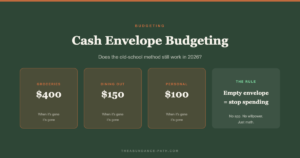 Budget
Cash Envelope Budgeting: Does the Old-School Method Still Work in 2026?
Stuffing cash into envelopes sounds outdated. But for people who overspend on cards, it's one of the most effective budgeting methods available. Here's the honest answer.
Read → Budget
Paycheck Budgeting: Exactly Where Your Money Should Go
Your paycheck hits your account. For a brief, beautiful moment, you feel rich. Then rent comes out. Then the car payment. Then…
Read →