Debt consolidation is one of the most searched personal finance topics — and one of the most misunderstood.
Used correctly, it can save you thousands in interest and simplify your payoff. Used carelessly, it can leave you in more debt than you started with.
Here’s the honest breakdown.
What Debt Consolidation Actually Means
Consolidation means combining multiple debts into a single loan or payment — usually with a lower interest rate than what you’re currently paying.
Instead of paying four credit cards at 18–24% interest, you take out one personal loan at 10% and pay them all off at once. Now you have one payment, one rate, and a clear payoff date.
That’s the ideal version. It doesn’t always work out that way.
When Consolidation Makes Sense
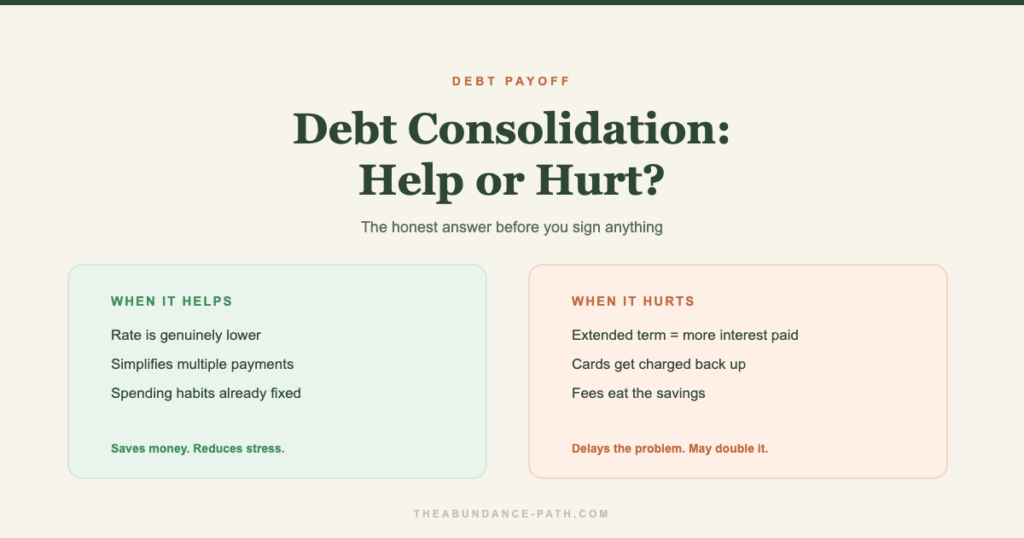
You qualify for a genuinely lower rate. If you can get a personal loan or balance transfer at a rate meaningfully below what you’re paying, consolidation saves real money. The math has to work.
You have multiple payments stressing you out. Managing five minimum payments across different due dates is mentally exhausting. One payment is simpler and harder to miss.
You’ve fixed the spending habits that created the debt. This is the critical one. More on it below.
When Consolidation Makes Things Worse
You extend the term to lower the payment. A longer loan term means more months of interest. You might lower your monthly payment but pay more overall. Always calculate the total cost, not just the monthly payment.
You run the cards back up. This is the most common consolidation failure. You pay off the credit cards with the consolidation loan — then slowly charge them back up. Now you have the loan payment AND new card balances. You’ve doubled your debt.
If your spending habits haven’t changed, consolidation just delays the problem. The debt didn’t go away. It moved.
The fees eat the savings. Balance transfer cards charge 3–5% upfront. Some personal loans have origination fees of 1–8%. Run the actual numbers before signing. Sometimes the fee costs more than the interest savings.
Your Options for Consolidating
Personal loan: Fixed rate, fixed term, one monthly payment. Best if your credit score is 670+. Rates vary widely — shop at least 3 lenders and use pre-qualification (no hard credit pull) to compare.
Balance transfer card: 0% promotional rate for 12–21 months. Best for smaller balances you can realistically pay off in that window. Watch the end date — the rate jumps dramatically when the promo expires.
Home equity loan or HELOC: Lower rates, but your home is collateral. If you can’t make payments, you risk foreclosure. Only consider this for large amounts where the math is compelling and your income is stable.
Debt management plan (DMP): A nonprofit credit counseling agency negotiates lower rates with your creditors and you make one payment to them. No loan required. Takes 3–5 years but protects your credit better than settlement. NFCC.org is a good starting point.
The Two Questions to Ask Before You Consolidate
1. Is the new rate actually lower? Don’t assume. Calculate total interest paid under both scenarios.
2. Have I fixed what caused the debt? If the answer is no, consolidation is a temporary fix that sets up a bigger problem. Get the spending under control first. Use our budgeting guide to build the system that prevents new debt from forming.
The Bottom Line
Consolidation is a tool, not a solution. Used at the right time with the right rate and a real budget behind it, it accelerates your payoff. Used as a quick fix without behavior change, it makes things worse.
Run the numbers. Fix the habits. Then decide.
Already decided on a payoff method? See Debt Avalanche vs. Snowball to pick the strategy that fits your personality.
More articles
 Debt Payoff
How to Pay Off Credit Card Debt Fast: A Step-by-Step Action Plan
Credit card debt is expensive and stressful — but it's beatable. Here's a step-by-step plan to pay it off faster than you think.
Read → Debt Payoff
How to Improve Your Credit Score Fast (The Only Steps That Actually Work)
Your credit score affects your rent, your loan rates, and even job offers. Here's exactly what moves the needle — and what's just a myth.
Read → Debt Payoff
Debt Avalanche vs. Debt Snowball: Which Method Gets You Out of Debt Faster?
Debt avalanche saves more money. Debt snowball builds momentum. Here's the honest comparison — and how to pick the right method for your personality.
Read →