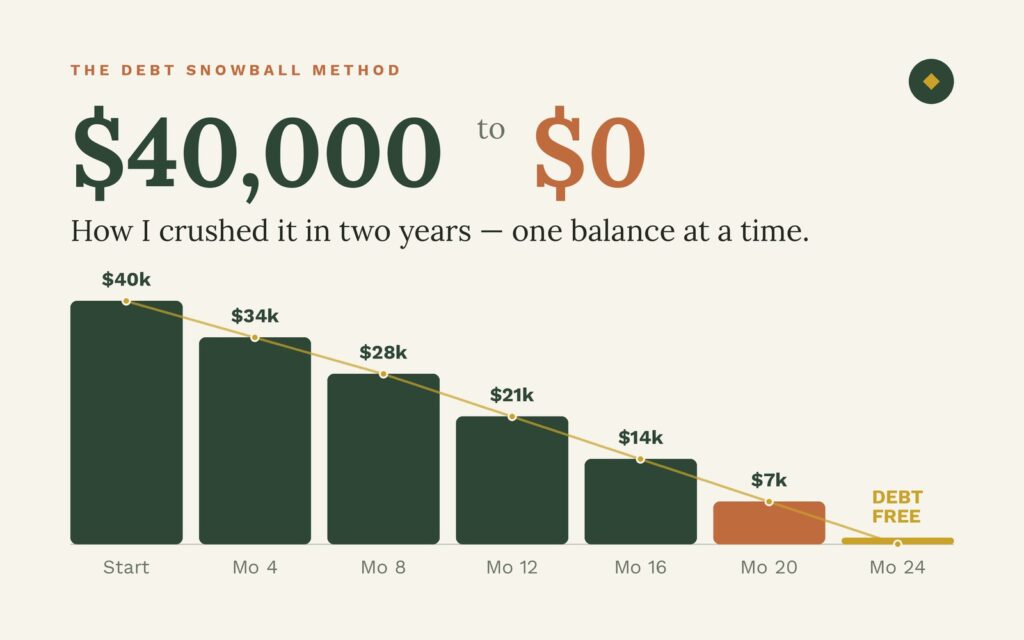
I had $40,000 in debt and no idea where to start.
Credit cards. A personal loan. A car payment. It felt like every time I made progress, another bill was waiting to knock me back down. I tried paying a little on everything, and nothing moved. I was exhausted and defeated.
Then someone told me about the debt snowball method. I rolled my eyes at first — it sounded too simple. But I tried it anyway.
Two years later, I was debt-free. Here’s exactly how the debt snowball method works and why it kept me going when everything else failed.
What Is the Debt Snowball Method?
The debt snowball method is a debt payoff strategy where you list all your debts from smallest balance to largest — and attack the smallest one first.
While you’re throwing every extra dollar at that smallest debt, you pay only the minimum on everything else. Once that smallest debt is gone, you roll that payment into the next one. And the next. And the next.
Like a snowball rolling downhill, your payments get bigger and bigger as you knock out each debt one by one.
It’s that simple. And that effective.
Step 1: List Your Debts Smallest to Largest
Grab a piece of paper — or open a spreadsheet — and write down every single debt you have. Credit cards, personal loans, medical bills, store cards, whatever it is.
Now order them from the smallest balance to the largest. Do not sort by interest rate. That’s the debt avalanche method, and it works mathematically — but most people quit before they see results.
With the debt snowball method, we’re playing the long game by winning the short game first.
Here’s what my list looked like when I started:
- Store credit card — $480
- Medical bill — $1,200
- Personal loan — $4,500
- Credit card #1 — $8,200
- Credit card #2 — $11,300
- Car loan — $14,320
Seeing it all laid out was sobering. But it was also the first time I had a real picture of what I was dealing with.
Step 2: Pay Minimums on Everything — Except the Smallest
Here’s where people mess up. They try to pay extra on every debt at once and make no real progress anywhere.
With the debt snowball method, you pay the minimum on every debt except the smallest. Every extra dollar you can find — from cutting subscriptions, picking up a side gig, skipping eating out — goes toward that smallest balance.
Minimum payments only keep you in debt. Extra payments actually destroy it.
I found an extra $200 a month by canceling two streaming services, packing lunch instead of buying it, and selling some clothes I never wore. Not glamorous. But that $200 took my store card from $480 to zero in under three months.
Step 3: Roll Each Payment Into the Next Debt
This is the move that makes the debt snowball method so powerful.
Once that first debt is gone, you don’t pocket that payment. You roll it onto the next debt. So now you’re throwing your minimum payment plus your extra $200 at the $1,200 medical bill.
When that’s gone? Roll that entire payment — minimum plus the extra — onto the personal loan.
Each time you knock one out, your snowball gets bigger. What started as $200 extra became $400, then $600, then $800 in extra monthly payments by the time I hit the bigger balances.
The momentum is the whole point.
Why the Debt Snowball Method Actually Works
Plenty of financial experts will tell you the debt avalanche is smarter — pay off the highest-interest debt first and you’ll save more money over time. Mathematically, they’re right.
But money is emotional. And most people don’t stick with the avalanche because they go months without seeing any real progress.
The debt snowball method works because of psychology. When you pay off that first small debt, something shifts. You feel it. You get a win. Your brain gets a hit of motivation that makes you want to keep going.
I paid off that store card in month three. I literally did a little dance in my kitchen. It was only $480 — but it was the first debt I had ever fully eliminated in my adult life. That feeling carried me through the next two years.
How to Find Extra Money to Throw at Your Snowball
The debt snowball method works faster the more you can throw at that smallest balance. Here are places to look:
Cut subscriptions. Go through your bank statement and cancel anything you’re not actively using. Most people find $50–$150/month hiding here.
Pause eating out. Even cutting back — not eliminating — can free up $100 or more monthly.
Sell stuff. Old electronics, furniture, clothes, sports equipment. One good weekend of selling can wipe out a small debt entirely.
Pick up extra hours or a side hustle. Freelancing, delivery apps, pet sitting — even $200 extra a month makes a significant difference over 24 months.
Use windfalls intentionally. Tax refunds, bonuses, birthday money — throw them at your snowball instead of spending them.
I wasn’t earning more money during those two years. I just stopped leaking it.
What Happens When You Hit a Big Debt?
Once you reach those larger balances — the $8,000 credit card, the $14,000 car loan — your snowball payment is massive. You’re not throwing a minimum at it. You’re throwing everything you’ve built up over months of wins.
My final payoff — the car loan — took eight months instead of the years it would have at minimum payment. Because by the time I got to it, I was throwing nearly $1,000 extra at it every month.
That’s the debt snowball method at full momentum.
One Thing to Do Before You Start
Before you attack your first debt, build a small emergency buffer — ideally $1,000. This isn’t your full emergency fund. It’s just enough to cover a car repair or unexpected bill without going back to your credit card.
If you skip this step, any surprise expense will knock you back to square one. A small buffer keeps your snowball rolling.
The Debt Snowball Method Changed More Than My Bank Account
When I made my final payment, I cried. Not because $40,000 was gone — though that was incredible — but because I had finally proven to myself that I could follow through on something hard.
The debt snowball method taught me discipline, momentum, and what it actually feels like to win with money.
You don’t need a perfect income or a financial degree. You need a list, a plan, and the willingness to celebrate each small win.
That’s the path. Small steps. Smart money. Big life.
Your snowball is waiting. Pick your smallest debt. Start today.
More articles
 Debt Payoff
How to Pay Off Credit Card Debt Fast: A Step-by-Step Action Plan
Credit card debt is expensive and stressful — but it's beatable. Here's a step-by-step plan to pay it off faster than you think.
Read → Debt Payoff
How to Get Out of Debt for Good: Break Free From the Cycle That’s Keeping You Broke
Read → Debt Payoff
How to Improve Your Credit Score Fast (The Only Steps That Actually Work)
Your credit score affects your rent, your loan rates, and even job offers. Here's exactly what moves the needle — and what's just a myth.
Read →