Debt is heavy. Not just on your wallet — on your mind.
It’s the number you think about at 2 a.m. It’s the reason a fun weekend comes with a side of guilt. It’s the quiet weight you carry everywhere.
And the worst part? It feels permanent. You pay and pay, and the balance barely moves. Like running on a treadmill that never stops.
Here’s the truth nobody tells you. You can get out. Not with a lottery ticket or a magic trick — with a plan. A boring, repeatable plan that works on a normal income.
This is your step-by-step guide on how to get out of debt for good. No shame. No gimmicks. Just the path out, one step at a time.
Why Debt Feels Impossible to Escape
It’s not your willpower. It’s the math.
When you only pay the minimum, almost all of it goes to interest. Barely any touches what you actually borrowed. So the balance crawls down while the interest piles back on.
Credit card companies design it that way. The minimum payment keeps you paying for years — sometimes decades — on a single balance.
Once you see the trap, you can beat it. The whole game is simple: pay more than the minimum, and aim that extra money like a weapon. Let’s build the plan.
Step 1: Stop the Bleeding
You can’t fill a bucket with a hole in the bottom.
Before you pay off a cent, stop adding new debt. Put the credit cards away. Freeze them. Delete the saved numbers from your shopping apps.
This isn’t forever. It’s just until you’re stable. You’re not punishing yourself — you’re stopping the leak so your hard work actually counts.
From today, you live on what you earn. That one decision changes everything.
Step 2: Face the Full Number
This part is scary. Do it anyway.
Write down every debt you have. All of it. Credit cards, car loan, student loans, that money you owe a friend. For each one, list three things:
- The total balance
- The interest rate
- The minimum monthly payment
Add up the balances. Yes, it’ll sting. But that number is your enemy, and you can’t beat an enemy you refuse to look at. Now it’s out of your head and on paper, where you can attack it.
Step 3: Build a Tiny Safety Net First
This feels backward. It isn’t.
Before you throw everything at debt, save a small starter emergency fund. Even $1,000. Here’s why: without it, the next flat tire or vet bill goes straight back on a credit card. And you’re trapped again.
A small cushion breaks that cycle. It’s the wall between you and new debt. Need a fast way to build it? Start here: How to Save $1,000 in 30 Days. Then keep growing it later with a full emergency fund.
Step 4: Pick Your Payoff Method
Now the fun part. You attack. There are two proven methods — pick the one that fits how your brain works.
The Debt Snowball (for motivation)
List your debts smallest to largest, ignore the interest rates. Pay minimums on everything. Then throw every spare dollar at the smallest balance.
Knock it out. Celebrate. Then roll that whole payment onto the next-smallest. The freed-up money snowballs and grows as you go.
Why it works: quick wins. You see a debt disappear fast, and that hit of progress keeps you going. Best if you need momentum to stay motivated.
The Debt Avalanche (for math)
List your debts by interest rate, highest first. Pay minimums on everything, then attack the highest-rate debt first.
Why it works: it saves you the most money in interest. It’s mathematically the fastest, cheapest route out. Best if numbers motivate you more than quick wins.
Which is better? The one you’ll actually stick with. Most people stay motivated with the snowball. Math nerds love the avalanche. Either beats doing nothing.
Step 5: Find Extra Money to Attack With
Both methods need one thing — extra money to throw at the smallest or highest debt. Here’s where to find it.
Build a real budget. A plan shows you exactly where your money leaks. Start with our complete budgeting guide or the simple 50/30/20 rule.
Cut the quiet drains. Audit your subscriptions and bills. Most people overpay without noticing — see 10 monthly bills you’re overpaying and things to stop buying to free up cash fast.
Add income. Even a small side gig speeds this up massively. Every extra $100 a month is $100 straight at your debt.
Every dollar you free up is a dollar that shortens your sentence. Hunt for them.
Step 6: Lower Your Interest Rates
Less interest means more of your payment kills the actual debt. Two quick moves:
Call and ask. Phone your credit card company. Ask for a lower rate. It works more often than you’d think, especially if you’ve paid on time. One call can save you hundreds.
Look at consolidation carefully. A balance-transfer card or consolidation loan can lower your rate. But read the fine print — fees and teaser rates can bite. It’s a tool, not a cure. The habits still matter most.
Step 7: Automate and Track Your Wins
Make minimum payments automatic so you never miss one. A missed payment means fees and a credit-score hit — exactly what you don’t need.
Then track your progress where you can see it. A simple chart on the fridge. A number on your phone. Watching the balance fall is fuel. Color in a box every time a debt dies.
Momentum is everything. The further you get, the easier it gets, because freed-up payments keep growing your attack.
A Real Example: The Snowball in Action
Numbers make it click. Say you have three debts:
- Store card: $500 balance, $25 minimum
- Credit card: $2,000 balance, $50 minimum
- Car loan: $6,000 balance, $200 minimum
You find an extra $150 a month in your budget. With the snowball, you pay every minimum, then add that $150 to the store card.
The $500 card gets $175 a month. It’s gone in three months. Now you take that whole $175 and add it to the credit card’s $50. That card now gets $225 a month.
See what happened? Your attack money grew from $150 to $225 without earning a penny more. Pay off the credit card, and all of it — $425 a month — rolls onto the car. That’s the snowball. It speeds up the closer you get.
How Long Will It Actually Take?
Honest answer: it depends on your balances and how much extra you throw at them. Could be one year. Could be four.
But here’s the part that matters. With a plan, you’ll have an end date. A real one. Right now your debt feels endless. The moment you map out the steps, “endless” turns into “month 18.” That finish line changes everything.
Run your numbers through a free debt payoff calculator to see your exact date. Watching that date get closer is its own motivation.
What If the Debt Is Too Big to Handle?
Sometimes the math doesn’t work. The debt is too large, the income too small, and no amount of budgeting closes the gap. That’s not failure. It just means you need bigger tools.
Credit counseling. A reputable nonprofit credit counseling agency can set up a debt management plan, often with lower interest. Look for “nonprofit” and check reviews carefully.
Debt settlement. This means negotiating to pay less than you owe. It can hurt your credit and comes with risks and fees — approach with caution and research hard.
Bankruptcy. The last resort, but a legal, legitimate fresh start when things are truly unmanageable. Talk to a qualified professional before deciding.
If you’re here, get free, unbiased help first. Don’t pay a company that promises to “erase” your debt overnight — that’s where scams live.
How to Stay Motivated to the Finish
The plan is simple. Sticking to it is the hard part. Here’s how to keep going.
Celebrate every payoff. Each debt that dies is a win. Mark it. Tell someone. Feel it.
Make it visual. A chart you color in beats a number in an app. Watching the bar shrink hits different.
Remember your why. You’re not just paying off debt. You’re buying back your freedom, your sleep, your choices. Picture life without the weight. That’s what you’re working toward.
Find your people. Online debt-free communities are full of folks cheering each other on. Borrow their momentum on the hard days.
Should You Pay Off Debt or Invest First?
It’s the question everyone asks. The answer comes down to one number: your interest rate.
High-interest debt wins every time. Credit cards at 20%+ are an emergency. No investment reliably beats that, so killing that debt is like earning a guaranteed 20% return. Pay it off first.
Low-interest debt is different. A car loan or student loan at 5% is less urgent. Here you can split the difference — pay it down steadily while also starting to invest a little, so you don’t lose years of compound growth.
One exception: if your job offers a 401(k) match, grab that even while paying debt. It’s free money you can’t get back later. When you’re ready for that side, here’s how to start investing.
Simple rule: torch the toxic high-rate debt first. Then balance paying off the cheap stuff with building wealth.
Mistakes That Keep People Stuck
- Paying only minimums. The trap itself. Always pay extra somewhere.
- No budget. Without a plan, the “extra” money vanishes before it reaches your debt.
- New debt while paying old debt. One step forward, one back. Stop the bleeding first.
- Skipping the starter fund. One emergency wipes out months of progress.
- Going it perfectly or quitting. Slip up? Don’t quit. Just get back on the plan tomorrow.
Your First Move
Don’t try to do all seven steps tonight. Just do step two. This week:
- Write down every debt — balance, rate, minimum.
- Add up the total. Face it.
- Put the credit cards away.
- Pick your method — snowball or avalanche.
- Find your first extra $50 to attack with.
That’s the start. Not the whole journey — just the first step out of the hole.
Drowning in debt or being harassed by collectors? Know your rights. The government’s free Consumer Financial Protection Bureau has real tools and no sales pitch.
Debt feels permanent until the day it isn’t. Thousands of people just like you have climbed out. They weren’t smarter or richer. They just started, and they didn’t stop.
Small steps. Smart money. Big life. Take the first step out today.
More articles
 Debt Payoff
Debt Consolidation: Does It Actually Help or Make Things Worse?
Debt consolidation sounds like a fix. Sometimes it is. Sometimes it makes things worse. Here's how to tell the difference before you sign anything.
Read → Debt Payoff
How to Pay Off Credit Card Debt Fast: A Step-by-Step Action Plan
Credit card debt is expensive and stressful — but it's beatable. Here's a step-by-step plan to pay it off faster than you think.
Read →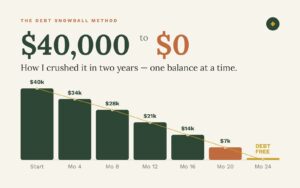 Debt Payoff
The Debt Snowball Method That Crushed My $40k Balance in 2 Years
The debt snowball method helped crush $40k of debt in 2 years. Here's exactly how it works, step by step, and why it actually keeps you going.
Read →